
OptiMATE 全自动密度梯度分液系统
专为优化密度梯度超速离心工作流而设计
OptiMATE 全自动密度梯度分液系统凭借自动化梯度液灌注与密封功能,可自动完成包括梯度制备、精准梯度液灌注和超离管密封等所有离心前步骤,将传统手工操作中繁琐且易出错的 密度梯度超速离心(DGUC)步骤,简化为易于维护的自动化工作流,显著缩短运行时间,并确保梯度构建的纯度或产量。
请求报价
选择 OptiMATE Gradient Maker 型号
OptiMATE 全自动密度梯度制备系统的优势功能
自动化梯度液灌注与密封
- 显著减少错误并提高可重复性
- 适配常见的贝克曼库尔特样品管尺寸
- 适配 Quick-Seal快封管, OptiSeal指封管,和开口管
预成型线性梯度
- 轻松生成线性梯度和阶梯梯度
- 显著缩短线性梯度构建的运行时间(缩减超 75%)
智能化操作界面搭配图形化方法创建
- 新操作员培训仅需几小时
- 标准化方法确保不同批次及操作员间实验结果的一致性
- 实时梯度曲线可视化掌控

自动化梯度液灌注与密封

预成型线性梯度

智能化操作界面搭配图形化方法创建
- 全自动分液与封管,轻松实现线性梯度与阶梯梯度构建
- 预成型线性梯度,显著缩短实验运行时间
- 全自动工作流,确保一致性,减少人工移液错误
- 无需专业经验,一键快速生成高质量梯度
- 广泛适用于 氯化铯 (CsCl), 碘克沙醇 (IDX)和蔗糖等多种介质
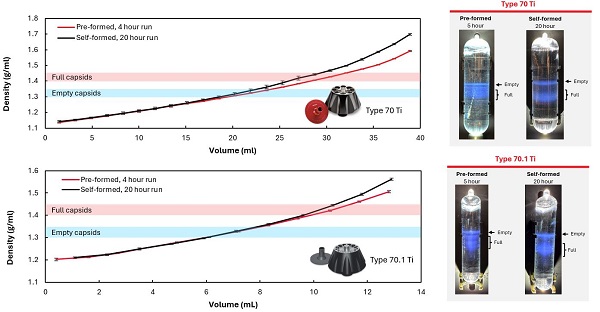
Although gradient profiles indicate sufficient separation even at 4 hours, control pre-formed experiments (left) were run for 5 hours while AAV pre-formed experiments (right) were run for 5 hours to improve band resolution/sharpness.
Accessories


Explore More Solutions for Density Gradient Centrifugation


技术文件
FAQ on the OptiMATE Gradient Maker
What tubes are compatible with the OptiMATE Gradient Maker?
Sizes
- 16 mm (8.9 to 13.5 mL)
- 25 mm (29.9 to 39 mL)
- 38 mm (94 mL)
- Quick-Seal
- OptiSeal
- Open-Top
- Polypropylene
- Ultra-Clear
What density gradient reagents are compatible with the OptiMATE Gradient maker?
- Cesium Chloride
- Iodixanol (OptiPrep™)
- Sucrose
Are the tubing lines reusable?
Yes, tubing lines are reusable. They have been tested to three runs.
Can I use 3rd-party tubes with the OptiMATE Gradient Maker?
No, OptiMATE is only compatible with ultracentrifuge tubes provided by Beckman Coulter Life Sciences.
What is density gradient centrifugation?
Density gradient ultracentrifugation (DGUC) is a centrifuge-based technique for providing superior purification of viral vectors (e.g., isolating full AAV particles from partial and empty capsids), along with other materials (such as plasmid DNA) in gene therapy production workflows. DGUC results in a layered gradient based on the density of materials in the original sample.
What applications is density gradient ultracentrifugation used for?
- Viruses / viral vectors (e.g., AAV)
- Virus-like particles and bacteriophage
- Extracellular vesicles (EVs)
- Proteins / protein complexes
- Lipid nanoparticles
- Synthetic nanoparticles or other nanomaterials
- Nucleic acids / plasmids
- Lipemic separations


