
OptiMATE Gradient Maker for Centrifugation
Automated Density Gradient Sample Preparation
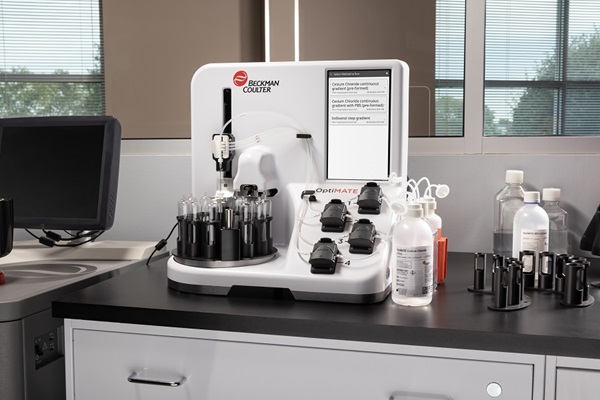
The OptiMATE Gradient Maker simplifies the laborious and error-prone density gradient centrifugation process into an easy-to-maintain operation by automating nearly all pre-centrifuge steps, including gradient preparation, accurate dispensing, and tube sealing, significantly reducing run times without sacrificing purity or yield. The OptiMATE Gradient Maker has achieved the ACT label in the US, EU, and UK.
Request Information or a Quote

Explore OptiMATE Gradient Maker Models
Features of the OptiMATE Gradient Maker
Automated dispense and tube sealing
- Significantly reduce error and improve reproducibility
- Compatible with most common Beckman Coulter tube sizes
- Compatible with Quick-Seal, OptiSeal, and Open-Top tubes
Pre-formed gradients
- Ability to dispense linear and step gradients
- Dramatically shorter run times (75+% reduction) for linear gradients
Simple GUI and method creation
- Train new operators in just hours, not weeks
- Published methods ensure consistency between runs and operators
- On-board visualization of gradient profiles

Automated dispense and tube sealing

Pre-formed gradients

Simple GUI and method creation
- Automated dispensing of both step and linear gradients, and automated tube sealing
- Significantly shorter run times by starting with pre-formed linear gradients
- Improved consistency – reduce errors with automation
- Generate high-quality gradients in just hours even without density gradient proficiency
- Compatible with cesium chloride (CsCl), iodixanol (IDX), and sucrose
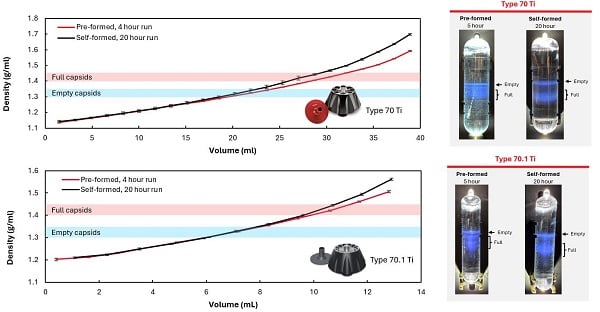
Although gradient profiles indicate sufficient separation even at 4 hours, control pre-formed experiments (left) were run for 5 hours while AAV pre-formed experiments (right) were run for 5 hours to improve band resolution/sharpness.
Additional Resources

Improving CsCl Density Gradient Ultracentrifugation Process Through Automated Gradient Formation: Evaluation of the OptiMATE Gradient Maker
Download Poster
5-hour Density Gradient Purification of Adeno-Associated Virus (AAV) Using a Novel Automation Platform – the OptiMATE Gradient Maker
Download Poster
Rapid, Automated Purification of Adeno-Associated Virus Using the OptiMATE Gradient Maker
Read Application Note
Reducing Variability and Hands-On Time in Viral Vector Purification Using the OptiMATE Gradient Maker
Read Application Note


Video Tutorials
The OptiMATE Gradient Maker supports density gradient workflows, automating gradient preparation, dispensing and tube sealing to enhance reproducibility and to free up your lab's time. If you want to learn more about how to set up and use the instrument, check out our videos below.
Accessories


Explore More Solutions for Density Gradient Centrifugation


Technical Documents
FAQ on Density Gradient Centrifugation Basics
What is density gradient centrifugation?
Density gradient ultracentrifugation (DGUC) is a centrifuge-based technique for providing superior purification of viral vectors (e.g., isolating full AAV particles from partial and empty capsids), along with other materials (such as plasmid DNA) in gene therapy production workflows. DGUC results in a layered gradient based on the density of materials in the original sample.
What applications is density gradient ultracentrifugation used for?
- Viruses / viral vectors (e.g., AAV)
- Virus-like particles and bacteriophage
- Extracellular vesicles (EVs)
- Proteins / protein complexes
- Lipid nanoparticles
- Synthetic nanoparticles or other nanomaterials
- Nucleic acids / plasmids
- Lipemic separations
OptiMATE Dispensing FAQs
What should I do if the instrument won't dispense, seems to dispense slowly, or the liquid level doesn't match the dispense volume?
- Check that the tubing is properly clamped in the pumps.
- Check for the correct tubing connection per the method being used and ensure that the tube is dipped such that the opening is below the liquid level.
- Ensure tubing lines that are in use are not pinched at the manifold.
- Ensure Luer locks are completely connected.
Why do I see bubbles on the top of the tube even after the tube is filled and sealed?
Bubbles can occur because of the sample composition. Small bubbles are acceptable and should not impact the centrifugation run. However, do not leave a large air space – too much air can cause tube deformation.
Can I leave the tubing in the pumps and for how long?
Yes, you can leave the tubings in the pumps, typically overnight clamping should not result in any issues. It is strongly recommended to clean the tubing prior to a shutdown of the instrument or longer periods of non-use.
Do I need to disconnect and remove reagent containers after every run?
- Leaving the dip tube / tubing set in your solutions can cause fouling and reduce the usable life.
- There is no need to disconnect when doing back-to-back runs. However, we recommend disconnecting reagents and sealing with the Luer caps provided and storing appropriately at the end of the day.
How do I avoid bubbles in my tubing?
- Ensure the dip tube is fully submerged, each reagent bottle has sufficient volume, and all Luer connections are securely attached.
- Ensure tubing set is properly primed and prime again as needed or until bubbles are removed.
- Small, immobile bubbles are generally fine and will not impact your gradient.
Do I need to prime the tubing again if I'm running the same method again?
No, you don't need to re-prime for back-to-back runs.
How often do I need to calibrate the instrument pumps?
- Calibrate the pumps at the start of each run.
- If running the same method consecutively, recalibration is not necessary.
- Always recalibrate when switching methods or reagents, or after any tubing has been disconnected.
How often should I replace the probe guide and how can I clean it?
Clean the probe after every use to avoid chemical deposits.
Can I use third-party tubing?
No, OptiMATE is only compatible with the tubing provided by Beckman Coulter Life Sciences.
Do I need to weigh tubes before centrifugation if I am loading the sample manually after the OptiMATE instrument dispenses into the tube?
If all samples loaded are of the exact same volume and gradient profile, then weighing is not required. However, re-calibration is necessary whenever the tubing set is replaced.
How often do I need to change the dispense probe?
Ensure the dispense probe is thoroughly clean between uses and the connection between the manifold is tight. There is no specification or recommendation for the frequency of probe replacement, as customer workflows and standard operating procedures vary dramatically. Ensure the dispense probe is not clogged or bent.
What density gradient materials can be used with the system?
Cesium chloride, iodixanol, and sucrose.
Are the tubing sets reusable?
Yes, tubing lines are reusable. They have limited reuse including two cleaning cycles with specified cleaning agents using 1 M sodium hydroxide, and 70% isopropyl alcohol. See instrument IFU for more information.
Can the tubing sets be sterilized?
Yes, tubing sets can be sterilized via autoclave or gamma irradiation but multiple cycles will reduce the operating lifespan.
OptiMATE Sealing FAQs
What tubes are compatible with the OptiMATE Gradient Maker?
Sizes:
- 16 mm (8.9 to 13.5 mL)
- 25 mm (29.9 to 39 mL)
- 38 mm (94 mL)
Formats
- Quick-Seal
- OptiSeal
- Open-Top
Materials
- Polypropylene
- Ultra-Clear
Filling and sealing performance are impacted by tube material, tube size, and tube volume. Not all tubes meeting the above criteria may be suitable. For a complete list of compatible rotors and tubes, please see the instrument brochure and instructions for use (IFU).
Can I use third-party tubes?
No, the OptiMATE system is only compatible with ultracentrifuge tubes provided by Beckman Coulter Life Sciences.
Do I need to remove the seal former when not in use?
A functional seal former does not need to be removed when not in use. However, it should be periodically inspected for residue or deformations and replaced as needed.
How often should I replace the seal former and how can I clean it?
Ensure the seal former is free of any residue for proper sealing.
Why didn’t the tube seal correctly?
- Ensure the seal former is free of residue and any defects, and replace if needed.
- Ensure the correct tube part number is chosen in the method.
Why did my tubes from the OptiMATE instrument deform or leak after centrifugation?
- Tubes filled and sealed using the OptiMATE system should perform as expected in the ultracentrifuge. Check the relevant rotor and tube instructions for use (IFU) to ensure the ultracentrifuge run settings were suitable.
- However, some users load their sample manually after gradient dispense, typically if they are loading different samples in a single run. If samples are topped off manually, wick off any excess liquid in the neck of the tube using a laboratory wipe prior to sealing.
- Ensure the seal former is free of residue and any defects, and replace if needed
Do I need to squeeze the tubes to check for leaks before centrifugation?
Tubes filled and sealed by the OptiMATE system should not need to be squeezed. Squeezing can disturb the gradient.
OptiMATE User Interface and Software FAQs
How do I save a method?
The OptiMATE instrument autosaves as changes are being made. However, published methods cannot be altered. They must be duplicated and renamed before editing.
How do I add a section to the top of the tube?
Refer to the OptiMATE system IFU. Briefly, add a section to the bottom of the tube, then click "Move Up" until it gets to the desired location.
Can I use the same method with different tube types or part numbers?
No, you must create a new method when changing tube types (unless changing only the number of tubes).
Why does the tube type matter for a method?
Filling and sealing performance are impacted by tube material, tube size, and tube volume.
Can I use the predefined reagents and methods provided with instrument?
Yes, but you should ensure they match your application needs.
Do I need to fill tubes all the way to the top?
Check the relevant rotor and tube instructions for use (IFU). Generally, all tubes should be filled to max volume for proper support during centrifugation, except for certain Open-Top, thickwall tubes which can be partially filled.
Can I unpublish or edit a published method?
No, once a method is published it is locked and can no longer be edited. It can be duplicated and then edited. It is also possible to delete methods.
